TEXAS SCHOOL COMPLIANCE GUIDE
Texas District Vulnerability Assessment: What TEA Checks at Your Doors
Every Texas school district receives a detailed vulnerability assessment from the Texas Education Agency once every four years, on a random basis TEA determines. TEA School Safety Agents review district policies and inspect campuses, and the district receives a report with recommendations and required corrective actions. This guide covers what the assessment checks, what TEA's statewide report for 2024-2025 found at exterior doors, and what a district owes after the visit.
Figures are from TEA's Annual Report 2024-2025: School Safety and Security in Texas. Its assessment results reflect approximately 30% of all Texas school districts.
The Short Version
What it is
A detailed review of a Texas school district's safety and security by the Texas Education Agency. It assesses facility access controls, emergency operations procedures, and other school safety requirements.
Who runs it
TEA School Safety Agents, using a rubric developed by TEA's Office of School Safety and Security in collaboration with the Texas School Safety Center. Results are recorded in Sentinel, TEA's school safety management system.
How often
Once every four years for each district, on a random basis TEA determines. To the greatest extent practicable, it coincides with the district's own safety and security audit.
What it covers
Eight district-level components based in statute, plus campus inspections that include facility access points, silent panic alert technology, and exterior windows.
What you receive
A report to the superintendent and the school safety and security committee that includes recommendations and required corrective actions to address any deficiencies in campus security TEA identified.
If issues remain
Under a rule effective September 1, 2026, the Commissioner of Education may assign a conservator to a school system that does not address issues identified through TEA monitoring, assessments, or audits within one year.
THE LAW BEHIND IT
Which Statute Requires What
| Citation | What it requires | Cycle or timing |
|---|---|---|
| Texas Education Code Section 37.1083 | TEA conducts a detailed vulnerability assessment of each school district that assesses facility access controls, emergency operations procedures, and other school safety requirements, using a rubric developed with the Texas School Safety Center. TEA then provides the superintendent and the school safety and security committee a report with recommendations and required corrective actions. | Once every four years for each district, on a random basis determined by TEA |
| Texas Education Code Section 37.108, safety and security audit | The district's own safety and security audit of its facilities, reported to the board of trustees and the Texas School Safety Center. The vulnerability assessment is to coincide with it to the greatest extent practicable. | At least once every three years |
| Texas Education Code Section 37.1085 and 19 TAC Section 103.1219 | The Commissioner of Education may assign a conservator when a school system fails to submit to required safety monitoring, assessments, or audits, fails to comply with applicable school safety requirements, or does not address issues TEA identified. | Issues addressed within one year. The rule became effective on September 1, 2026. |
| Texas Education Code Section 37.1083, confidentiality | Any document or information relating to TEA's monitoring of school district safety and security requirements is confidential and not subject to disclosure under Chapter 552, Government Code. | Applies to all monitoring under this section, including the assessment |
| Texas Education Code Section 37.1088 | TEA reports the deidentified results of vulnerability assessments and intruder detection audits to the governor, the lieutenant governor, the speaker of the house, and the relevant legislative committees, with recommendations and possible corrective actions for deficiencies found at multiple districts. | Not later than December 31 of each year |
Not legal advice. This guide summarizes the statutes and TEA's published materials for planning. For what your district must do, rely on your district's assessment report and TEA's Office of School Safety and Security.
WHAT IT CHECKS
What the Assessment Covers
TEA School Safety Agents assess the district's written and implemented school safety policies and procedures. At the campus level, they review how those procedures are carried out, with security inspections of instructional facilities and a look at staff knowledge and preparedness in emergency scenarios.
District-level review: eight components based in statute
- Multihazard EOP implementation
- Communications
- Safety committee
- Facility standards
- SSSP team
- School security
- First aid
- Policy and procedure
Campus-level review: the categories TEA lists
- Drill schedule
- First aid
- Facility access points
- Silent panic alert technology
- Exterior windows
- Maps and master key box
Facility Access is where exterior doors are inspected. TEA describes it as verifying that exterior doors remain closed, latched, and locked by default, that staff can see individuals seeking entry, that door construction is intrusion resistant with reinforced glass, that master key access systems work, that visitor check-in areas have physical barriers, that roof access is locked, and that weekly exterior door inspections are being done.
These categories are TEA's own summary from its annual report. TEA's assessment rubric itself is not reproduced here.
STATEWIDE FINDINGS
What the 2024-2025 Assessments Found at Exterior Doors
The 2024-2025 District Vulnerability Assessment (DVA) Cycle marked the first full year of statewide implementation. TEA states each finding as a share of the campuses, districts, or school systems it assessed. None of these figures is a share of every Texas campus.
99.28%
of campuses conduct weekly inspections of exterior doors during regular school hours.
36.57%
of campuses had one or more exterior access points that were not closed, latched, and locked, or an exterior door that did not function properly to automatically close, latch, and lock.
Weekly inspection is close to universal among assessed campuses, yet more than a third had an exterior door that was not secured or did not secure itself.
| Area | Finding in TEA's 2024-2025 report |
|---|---|
| Door labeling | 45.52% of campuses did not have proper alphanumeric labeling on all exterior doors. |
| Door construction and glass | 41.85% of campuses had one or more exterior doors that were not built or modified to resist forced entry, or glass panels not reinforced against easy breakage. |
| Seeing who is at the door | 38.85% of campuses had one or more doors that did not have a way to visually identify an individual seeking access to the building or classroom with an exterior door. |
| Doors closed, latched, and locked | 36.57% of campuses had one or more exterior access points that were not closed, latched, and locked, or an exterior door that did not function properly to automatically close, latch, and lock. |
| Campus maps | 28.60% of campuses did not have an accurate campus map depicting interior and exterior doors with alphanumeric labels on a floor plan per Texas Administrative Code, or did not have an accurate map readily available in the campus main office. |
| Windows next to doors | 22.56% of campuses have windows adjacent to exterior doors that are not constructed or modified with intruder-resistant material. |
| Twice-yearly maintenance checks | 19.20% of school systems did not meet the requirement to perform and document twice-yearly maintenance checks. |
| Door numbering plans for 9-1-1 | 9.33% of districts have not shared electronic copies of exterior and interior door numbering plans with the local 9-1-1 administrative entity. |
The report's own summary: Gaps continue in exterior door security, window reinforcement, threat assessment training, and facility maintenance.
TEA adds its own caution: its recommendations are based upon a limited sample size, approximately 30% of all Texas school districts.
TEA's next annual report is due not later than December 31. Positive Proof will update this guide when it is published.
TWO DIFFERENT REVIEWS
The Vulnerability Assessment and the Intruder Detection Audit Are Different
Besides a district's own safety and security audit, two reviews come from outside the district.
| Compared | District Vulnerability Assessment | Intruder Detection Audit |
|---|---|---|
| Statute | Texas Education Code Section 37.1083 | Texas Education Code Section 37.1084 |
| Who conducts it | TEA School Safety Agents | A school safety review team in each region served by a regional education service center |
| How often | Each district once every four years, on a random basis | Annually, at school district campuses in the team's region |
| What it covers | District policies and procedures, plus campus inspections of facility access controls, emergency operations procedures, and other school safety requirements | On-site general intruder detection audits of school district campuses |
| What follows | A report to the superintendent and the school safety and security committee with recommendations and required corrective actions | A report to the superintendent and the school safety and security committee with recommendations and required corrective actions |
| Confidentiality | Documents and information are confidential | The audit report is confidential |
| If problems persist | A conservator may be assigned when issues are not addressed within one year | The same conservator rule, plus TEA's multi-tiered Enhanced Monitoring Plan for campuses with persistent Intruder Detection Audit findings |
For the audit's phases, its statewide results, and its corrective action list, see the Texas intruder detection audit guide.
AFTER THE ASSESSMENT
After the Assessment: What the District Owes
Receive the report.
TEA provides the superintendent and the school safety and security committee a report on the results of the assessment that includes recommendations and required corrective actions.
Collaborate on the timelines.
DVA results are recorded in Sentinel and shared with the district superintendent to support collaboration on timelines for addressing identified deficiencies.
Report completion.
School districts are required to report completed corrective actions to TEA for final review and approval within the specified timelines.
Know the one-year conservator rule.
Under 19 TAC Section 103.1219, the Commissioner of Education may assign a conservator to a school system that does not address issues identified through TEA monitoring, assessments, or audits within one year.
PREPARE
A Door Self-Check Before the Next Assessment
These steps follow the door findings above. They are Positive Proof's suggestions for preparing, not TEA's rubric, and none of them requires a door-monitoring system.
Test every exterior door, not just look at it.
Open each exterior door and let it go. It should close, latch, and lock on its own. The closed, latched, and locked finding includes exterior doors that did not function properly to automatically close, latch, and lock, which a glance at a shut door can miss.
Keep the weekly inspection records complete.
TEA's Facility Access review includes reviewing weekly exterior door inspections. Record each week who checked which doors, what was found, and what was repaired. For what the weekly rule itself requires, see Texas school door security requirements.
Label every exterior door and fix the map.
45.52% of campuses did not have proper alphanumeric labeling on all exterior doors. Check the labels against an accurate campus map in the main office, then share the door numbering plan electronically with your local 9-1-1 administrative entity.
List doors and windows that would not resist forced entry.
Door construction or glass was a finding at 41.85% of assessed campuses. Windows next to exterior doors were a finding at 22.56%. Put both on the facilities list with a cost and a date.
Make sure staff can see who is at the door.
Check every entrance a visitor might use, including classroom doors that open to the outside.
Schedule and document the twice-yearly maintenance checks.
19.20% of school systems did not meet the requirement to perform and document twice-yearly maintenance checks. Include door closers, latches, and locks, and keep a procedure for staff to report a failing door immediately.
CLOSING THE GAP
Where Door Monitoring Fits, and Where It Does Not
The weekly inspections TEA reviews are meant to ensure exterior doors remain closed, latched, and locked, and cannot be opened from the outside without a key.
A weekly inspection shows a door's condition at the moment someone checks it. A door propped open on a Tuesday afternoon, or a closer that stops pulling the door shut, can go unnoticed until the next inspection or the next assessment.
TEA's report also recommends enhanced monitoring, technical support, and training for districts with campuses having recurring deficiencies pertaining to access control issues. Those are state oversight measures, separate from any door-monitoring product.
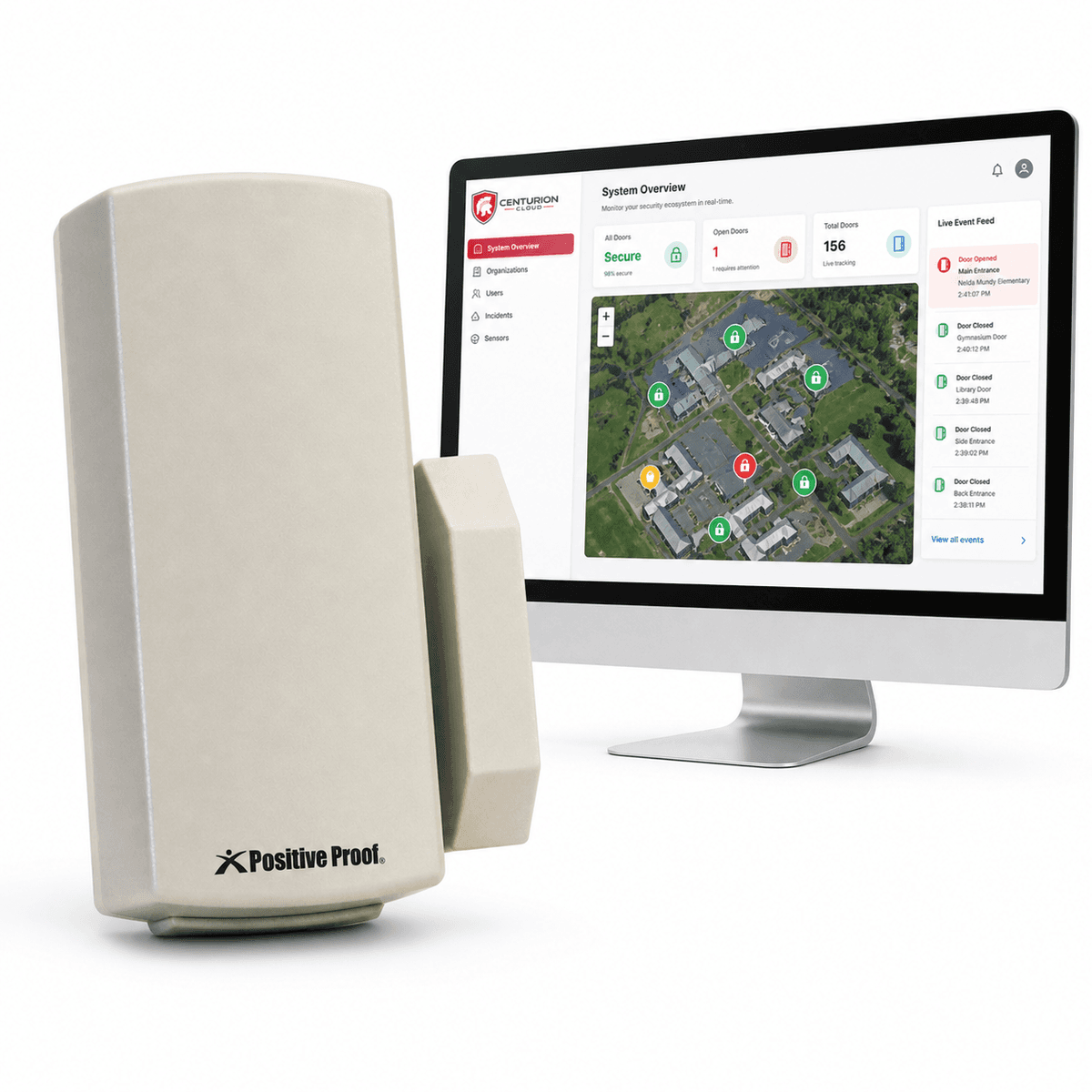
Positive Proof Door Monitoring puts a wireless sensor on each exterior door and reports its status continuously, with an alert the moment a door is propped, forced, or held open past the limit set for it. The same door event can reach a resource officer's two-way radio, a front-office email, and dispatch at the same moment, and every event is logged for corrective action records and board reporting. A contact sensor proves a door is closed, not latched or locked, so door monitoring supports the weekly inspection and hardware repair. It does not replace either.
Door monitoring does not repair a door's construction or glass, label doors, correct the campus map, or share the 9-1-1 numbering plan. Those findings need repairs, labeling, and records. Silent panic alert technology is its own campus category in the assessment, separate from doors. See Positive Proof panic buttons.
Weighing monitoring against wiring more doors? See the door monitoring vs access control comparison. See how every state handles school door security.
Preparing for an Assessment or Answering a Finding?
Schedule an exterior door review with Positive Proof. The review walks your exterior door list, identifies which openings have no way to report their status, and shows what continuous monitoring and automatic logging would look like across your campuses.
Schedule an Exterior Door ReviewCommon Questions About the District Vulnerability Assessment
What district safety teams ask about the assessment, answered from the statute and TEA's published materials.
Official Sources
- Texas Education Agency, Annual Report 2024-2025: School Safety and Security in Texas (PDF)
- Texas Education Code Chapter 37: Discipline, Law and Order
- Texas Education Agency, School Safety Updates, September 24, 2026: the conservator rule
- Texas Education Agency, School Safety Updates, April 16, 2026: the Enhanced Monitoring Plan
YOUR NEXT STEP
Close Exterior Door Findings Before Your Next Assessment
Each district is assessed once every four years, and the Commissioner may assign a conservator when issues TEA identifies are not addressed within one year. Exterior doors are something a district can check every week, and a door left open can be reported the moment it happens.
Schedule an Exterior Door Review