Panic Buttons
Room-level duress alerts reaching security in under 2 seconds
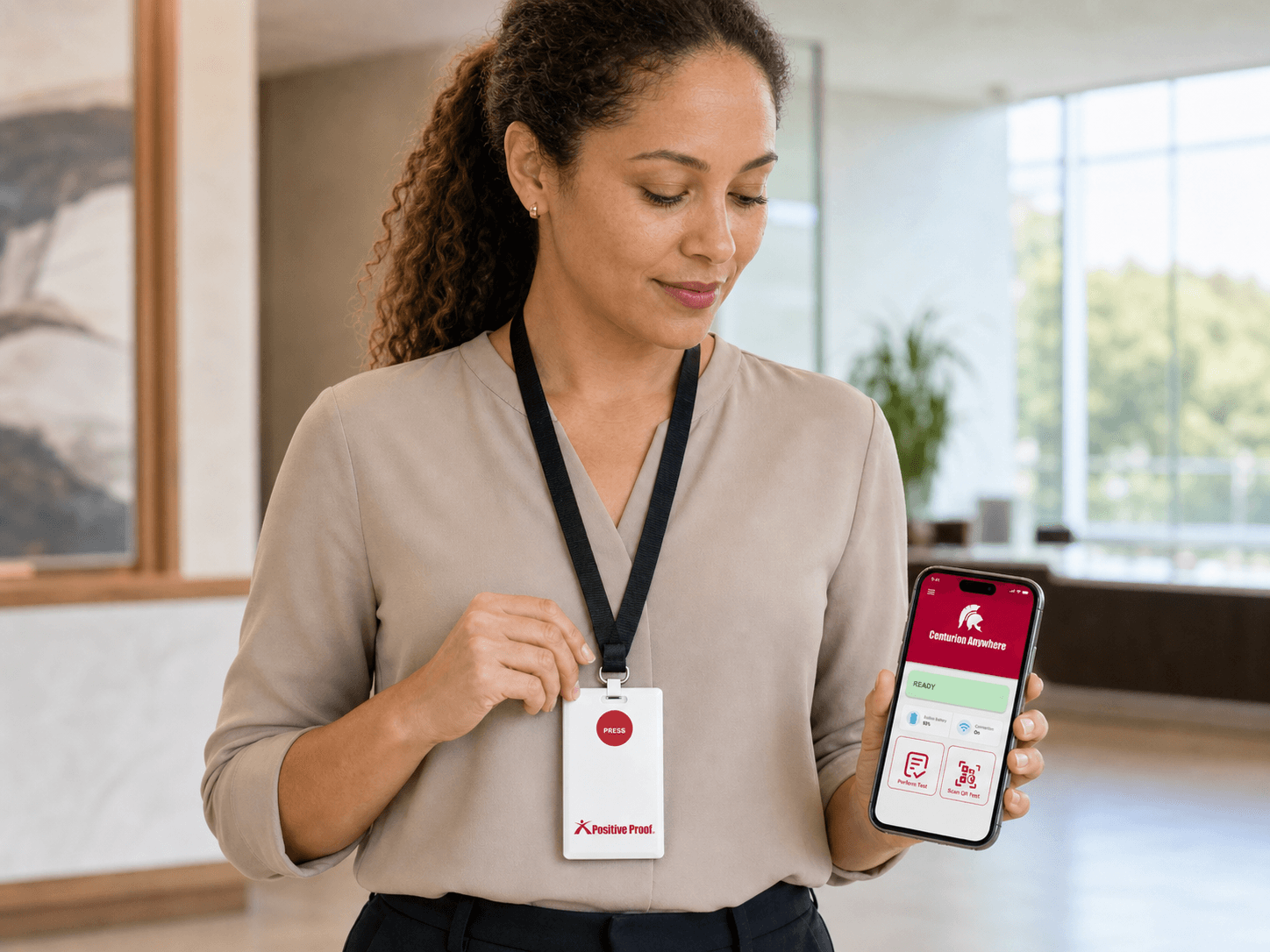
Explore Panic Buttons84.8% of registered nurses in a 2025–26 National Nurses United survey reported workplace violence in the past year. Positive Proof gives nurses room-level protection in 2 seconds, no app required.
Request a Demo
THE HEALTHCARE ENVIRONMENT
Workplace violence is the defining safety crisis in healthcare today. In National Nurses United's 2025–26 survey, 84.8% of registered nurses reported at least one type of workplace violence in the past year — nurses facing combative patients, behavioral health workers managing acute psychiatric incidents, and pharmacists working alone in restricted areas after hours. Most facilities have emergency call systems, but those systems require picking up a phone or reaching a wall-mounted device. In a threatening situation, that delay is the problem.
Most panic button solutions compound this failure in a different way. Systems that depend on a smartphone or a separate app are not worn by the staff who need them most. Back-unit nurses, behavioral health technicians, and laboratory staff leave their phones at their workstations or in their lockers. A system that requires a smartphone protects staff on the sales floor, not the psych unit or the dispensary. Peer-reviewed research confirms that in many healthcare deployments, the majority of clinical staff do not wear the issued panic device because of bulk, unfamiliarity, or inadequate training.
The regulatory pressure is accelerating. OSHA has no health care workplace violence standard, no Joint Commission workplace violence requirement names a device, and Illinois SB 1435, which would put one on the ID badge of every hospital employee, has not passed. California SB 553 requires workplace violence prevention plans for virtually all employers. As of June 2024, 48 states had enacted at least one law addressing workplace violence in health care settings, and 27 had enacted prevention laws (Health Affairs Scholar, 2026). Facilities that have not implemented a documented staff alerting system face increasing exposure during Joint Commission surveys and CMS compliance reviews.
For what OSHA, CMS, the Joint Commission and the state laws we reviewed say, quoted source by source, read Are Panic Buttons Required in Hospitals?
24/7 operations with visiting hours, shift changes, and isolated clinical areas creating continuous high-volume staff safety challenges across every unit
84.8% of registered nurses in a 2025–26 National Nurses United survey reported workplace violence in the past year — behavioral health units and emergency departments face the highest incident rates
Illinois SB 1435 would require a panic button on every hospital employee badge but has not passed — 48 states had a health care workplace violence law as of June 2024
WHAT'S AT STAKE
Five scenarios hospital safety directors and CNOs work to prevent — and the compliance exposure that makes inaction increasingly costly.
POSITIVE PROOF FOR HEALTHCARE
One platform protects clinical staff throughout the facility, screens every visitor before they reach patient care areas, and monitors every access point in real time.
Four outcome areas that matter most to hospital safety directors, CNOs, and facilities teams.
2 Sec
Alert-to-Responder Time
96-98%
Staff Report Feeling Safer After Deployment
48
States With a Health Care Workplace Violence Law (June 2024)
A 30-minute demo is configured to your facility type, patient population, and existing security infrastructure.
Request a DemoWhat hospital safety directors and CNOs ask before evaluating staff duress systems.
One provider for clinical staff safety, visitor screening, and every access point in your facility.
Request a Demo