Home → Industries → Retail

Retail Panic Button System — Built for Staff Working Alone

NY, CA, and WA retail safety laws are setting deadlines for silent response buttons. Positive Proof gives store employees one-touch protection anywhere in your building — no app, no Wi-Fi, no smartphone required.

Request a Demo
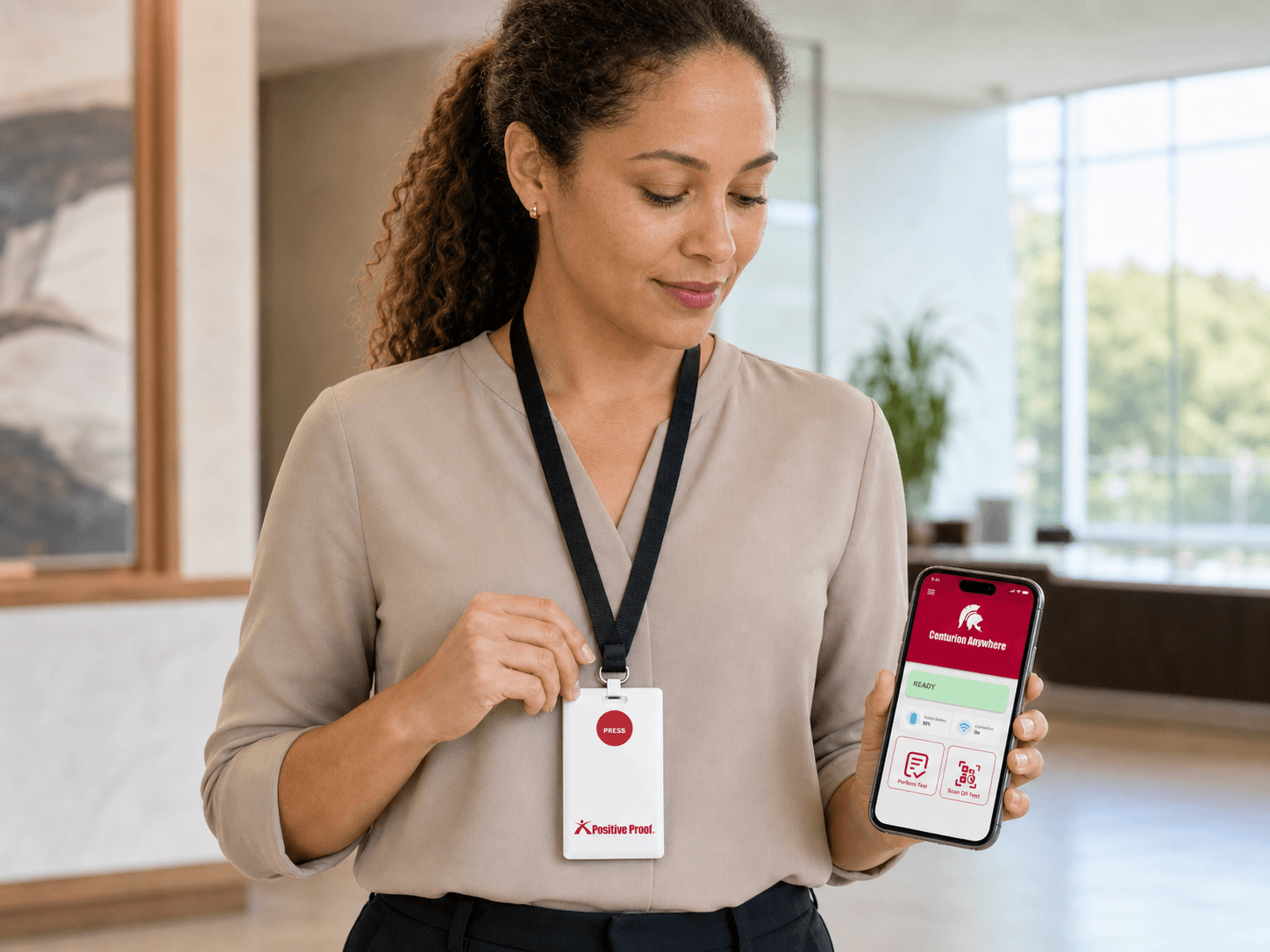
Retail panic button system — Positive Proof staff safety solutions for retail stores

THE RETAIL ENVIRONMENT

Why Most Retail Panic Buttons Don't Protect Your Back-of-House Staff

US retail workers report 867 violent incidents every day — cashiers facing hostile customers, loss prevention staff confronting ORC suspects, and associates working alone in stock rooms and receiving areas with no fast path to help. Customer aggression has increased alongside organized retail crime, and the staff most at risk are often working in the places where your building's visibility is lowest.

Three states have already moved to mandate silent response buttons for retail workers. California's workplace violence prevention law took effect July 2024. Washington state's isolated worker protection rule took effect January 2026. New York's Retail Worker Safety Act requires silent response buttons for retailers with 500 or more employees by January 1, 2027. Retailers operating in multiple states face overlapping compliance timelines — and the window for evaluation and deployment is shorter than most LP and HR teams realize.

Most panic button solutions require employees to carry a smartphone or download an app. In retail, that means coverage fails exactly where incidents happen most. Back-of-house employees often don't carry phones on shift. Fitting room associates, stock room workers, and loading dock staff leave their phones in their lockers. A solution that depends on a smartphone is a solution that covers your sales floor and almost nowhere else.

867 violent incidents reported daily against US retail workers — cashiers, LP staff, and associates working alone face escalating confrontation and ORC incidents

NY, CA, and WA have enacted retail worker safety laws with specific silent response button requirements — enforcement is already active in two states

Back-of-house staff in stock rooms, fitting rooms, and loading docks work in isolation — most panic solutions require a phone these employees don't carry on shift

WHAT'S AT STAKE

The Safety Gaps That Put Retail Staff at Risk

Five scenarios retail operations teams work to prevent — and one compliance deadline that makes inaction increasingly expensive.

Customer Confrontation

A cashier faces a physically threatening customer and cannot trigger a visible alarm without escalating the situation. Security arrives minutes after the incident — too late to intervene.

Isolated Closing Shift

An associate counting the register at close is the last person in the building. No manager nearby. No fast way to reach law enforcement if someone follows them through the parking area.

Back-of-House Incident

A stock associate in a large warehouse-format store encounters a threatening situation. Their phone is in their locker. No Wi-Fi in the receiving area. No path to get help quickly.

ORC Escalation

An LP director attempts to detain a suspect during an organized retail crime incident. The situation escalates and communicating location while managing the interaction costs critical seconds.

Compliance Deadline Exposure

A retailer with 600 employees has not deployed silent response buttons by the NY January 1, 2027 deadline. Penalty exposure, employee relations fallout, and potential litigation compound the cost of delay.

What Positive Proof Delivers for Retail Safety

Four outcome areas that matter most to loss prevention directors and retail operations managers.

Security Improvement

  • Discreet wearable activation — no visible button press needed
  • Sub-2-second alert delivery to LP and security staff
  • Full coverage in Wi-Fi dead zones and back-of-house areas
  • Real-time door status for stock rooms and receiving access points

Operational Efficiency

  • No-app wearable, proven across 25+ years of K-12 deployment across all roles
  • Multi-location administration from one centralized dashboard
  • Fast check-in for credentialed service contractors and delivery staff
  • After-hours access logging for receiving and maintenance windows

Compliance Protection

  • NY Retail Worker Safety Act silent response button compliance
  • CA OSHA Workplace Violence Prevention Plan documentation support
  • WA isolated retail worker protection requirements
  • OSHA General Duty Clause incident documentation

Reporting & Visibility

  • Timestamped incident alert log for every staff activation
  • Door event history by location and shift window
  • Exportable records for loss prevention investigations
  • Compliance audit trail for state regulatory review

2 Sec

Alert-to-Responder Time

96-98%

Staff Report Feeling Safer After Deployment

Jan 2027

NY Retail Worker Safety Act Deadline for Silent Response Buttons

See Which Retail Safety Laws Apply to Your Stores

A 15-minute conversation covers which state mandates apply and what deployment looks like across your locations.

Request a Demo

Common Questions About Retail Worker Safety

Answers for loss prevention directors and HR managers evaluating retail panic button requirements.

It depends on your state and employee count. California requires a written workplace violence prevention program for virtually all employers, effective July 2024, with documentation requirements for incidents. Washington state requires single-action panic buttons for isolated retail workers, effective January 2026. New York requires silent response buttons for retailers with 500 or more employees, effective January 1, 2027. Retailers operating in multiple states often face overlapping timelines — a single platform that satisfies all three reduces compliance complexity.
Three states have enacted retail-specific worker safety laws that include panic button or silent response button requirements: New York (Retail Worker Safety Act — silent response buttons required for 500+ employee retailers by January 1, 2027), California (OSHA Workplace Violence Prevention Plan, effective July 1, 2024 — documentation and incident response protocols), and Washington state (isolated retail worker protection, effective January 1, 2026). Additional states are tracking similar legislation. Retailers evaluating systems now are positioning ahead of further mandates.
The New York Retail Worker Safety Act defines a silent response button as a device that allows a worker to signal for help without making noise or drawing attention from the person creating the threat. The law requires retailers with 500 or more employees to install silent response buttons — wearable, fixed, or on employer-provided devices — by January 1, 2027. Positive Proof's wearable panic device satisfies this definition. It operates on an independent facility-deployed network — not Wi-Fi, not a smartphone — which provides coverage across the entire store, including back-of-house areas where app-based solutions fail.
App-based panic solutions work for employees who carry smartphones on shift. The problem is that many retail workers don't — back-of-house staff, stock associates, and fitting room employees often leave phones in their lockers. An app-based solution delivers partial coverage at best: it protects the sales floor and leaves back-of-house staff unprotected. Positive Proof's wearable device requires no smartphone, no app, and no Wi-Fi. Staff press once and the alert reaches security in 2 seconds regardless of where in the building they are.
Opening and closing shifts are the highest-risk windows in retail: one or two associates present, reduced visibility, and cash handling in progress. Positive Proof's wearable panic button works the same at 6 AM and 11 PM as it does at peak hours — the facility-deployed network is always active, independent of shift staffing or building Wi-Fi. Alerts go directly to designated responders — LP, security, or 911 — regardless of whether a manager is physically present. Retailers commonly pair the panic system with door monitoring alerts during opening and closing to flag unauthorized access in real time.
Positive Proof integrates with most commercial loss prevention systems via API and webhook. Panic alerts can feed directly into existing security dashboards, camera systems, and incident management platforms. If a specific integration is required, Positive Proof builds it as part of the deployment process. The system is designed as an infrastructure-layer addition — it operates alongside your existing LP technology without replacing it. Deployment does not require changes to your existing network or access control setup.

Ready to Meet Every Retail Safety Deadline?

Protect your staff and stay ahead of NY, CA, and WA compliance requirements.

Request a Demo