Home → Industries → Hotels & Hospitality

Hotel Panic Button System — Housekeeping and Staff Safety Compliance

Illinois, New Jersey, Washington, California cities, New York City, Nevada, and Florida all mandate panic buttons for hotel workers — with compliance deadlines that have already passed in most jurisdictions. Positive Proof delivers wearable staff safety devices that operate on a facility-deployed network, reaching security in 2 seconds with coverage in basement laundry rooms, parking garages, and every guest floor.

Request a Demo
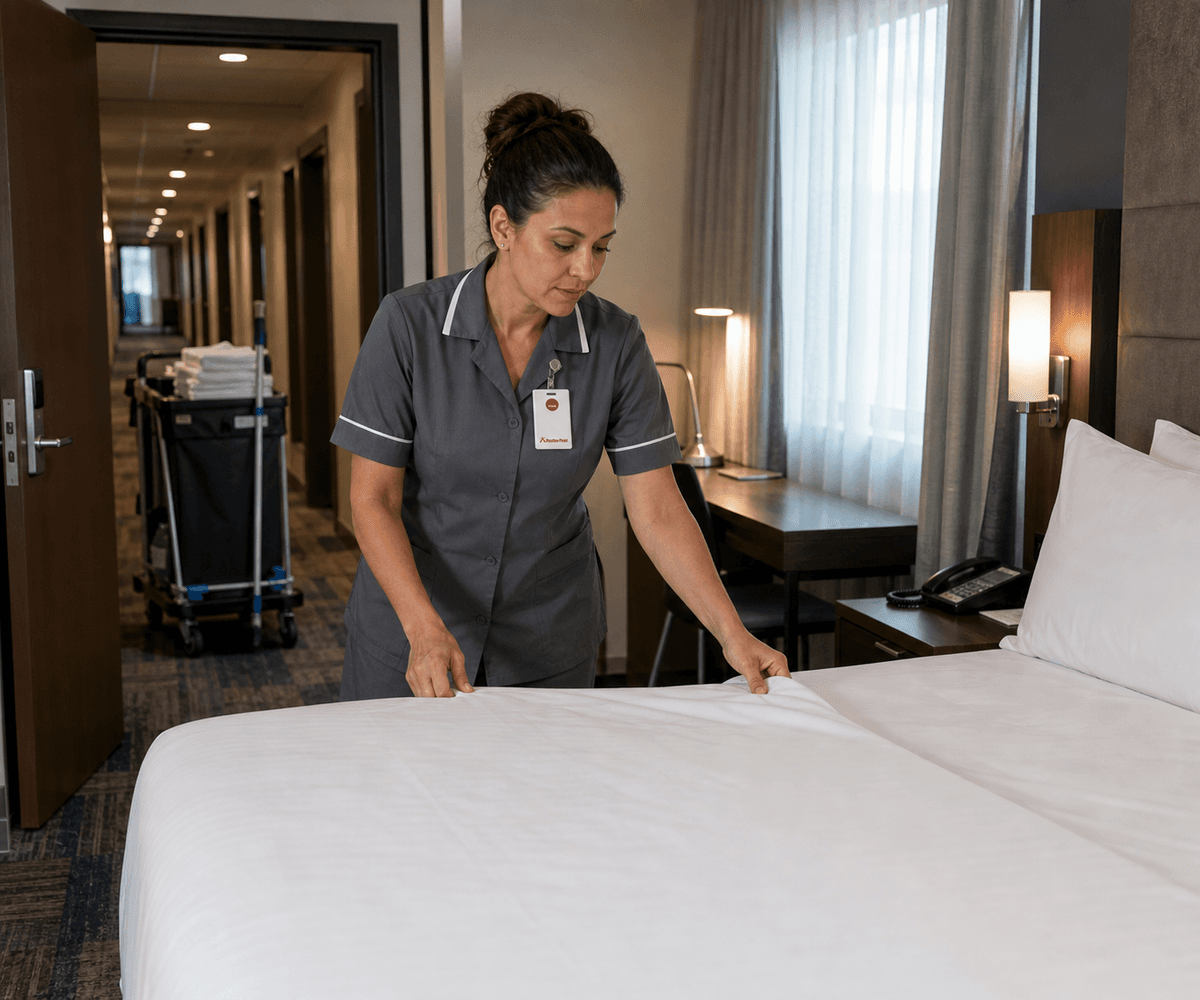
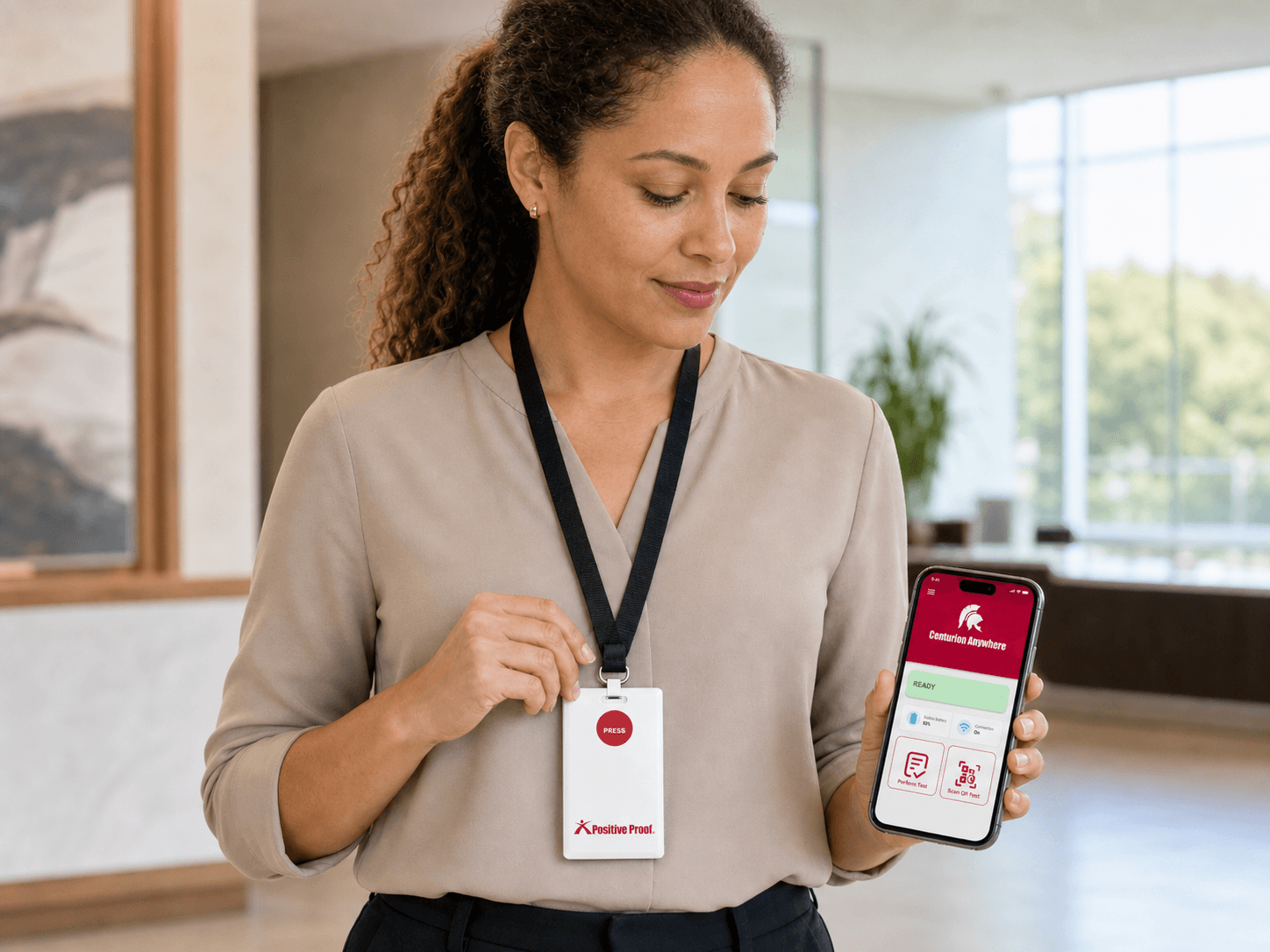
Hotel panic button system — Positive Proof staff safety device for housekeeping, room service, and hospitality workers

THE HOTEL ENVIRONMENT

Hotel Workers Are Isolated and Regulated — Most Panic Button Systems Leave Gaps

Housekeeping staff, room service attendants, and mini-bar attendants spend their entire shift working alone in occupied guest rooms — the highest-risk environment in any hospitality property. More than ten US states and cities now mandate that hotels provide a personal safety device to every employee working in isolated or guest-facing roles. Illinois, New Jersey, Washington State, New York City, Nevada, Florida, and major California cities including Los Angeles, Oakland, Sacramento, and Santa Monica all have active requirements. In most jurisdictions, compliance deadlines have already passed. Non-compliant hotels face fines of up to ten thousand dollars per violation.

The physical reality of hotel construction compounds the coverage problem. Thick concrete floors between guest levels, elevator shafts, basement laundry facilities, and parking garages create dead zones where Bluetooth-based panic button systems lose location precision and cellular signals drop. The dominant hotel panic button systems — React Mobile and ROAR for Good — depend on Bluetooth beacons and cellular fallback. These systems can identify the floor a worker is on, but in basement laundry rooms, below-grade parking structures, and older concrete-frame properties, signal quality degrades where workers need coverage most. Positive Proof's facility-deployed network penetrates these structures entirely and requires no Bluetooth beacons, no hotel WiFi, and no smartphone.

State regulations are more demanding than many hotel operators realize. Illinois 820 ILCS 325 requires activation logs documenting every device use, written anti-sexual harassment policies, and paid time off for employees who need to file police reports or testify in legal proceedings. New Jersey S.2986 requires hotels to maintain records of all accusations against guests and report incidents to law enforcement. Washington SB 5258 requires panic buttons for all employees providing in-room services at properties with sixty or more rooms. Every jurisdiction requires the device to summon a specific responder to the employee's precise location — noise-makers, whistles, and alarm bells explicitly do not qualify.

Housekeeping, room service, and mini-bar staff spend entire shifts working alone in occupied guest rooms — the highest-risk environment in any hotel property

10+ states and cities mandate hotel panic buttons — with compliance deadlines already passed in IL, NJ, WA, CA cities, NYC, NV, and FL — and fines up to $10,000 per violation

Concrete construction, elevator shafts, and basement facilities create dead zones where Bluetooth-based systems lose precision and cellular drops in exactly the areas staff work most

WHAT'S AT STAKE

The Scenarios Hotel Safety Directors Work to Prevent

Each scenario represents a documented gap in legacy hotel safety programs — and a direct line to regulatory violation, staff harm, or post-incident liability.

Housekeeping Room Incident

A room attendant enters an occupied room to service it and encounters a threatening guest. She has no panic device — her employer issued app-based safety software that requires a smartphone, and her phone is in her locker per hotel policy. She has no way to silently summon help without escalating the situation.

Basement Laundry Dead Zone

A housekeeper working in the basement laundry room activates her Bluetooth panic button after a confrontation with a maintenance contractor. The nearest beacon is on the floor above. Location data shows 'Floor 1' — not the basement. Security responds to the wrong location. The employee is alone in the basement for 6 minutes before anyone arrives.

Parking Garage After-Hours

A valet attendant is assaulted in the parking structure during a late shift. The parking garage has no WiFi coverage and no Bluetooth beacons. Her panic button is cellular-dependent. The signal never transmits. No alert reaches the front desk.

Room Service Confrontation

A room service attendant delivering to an occupied room encounters a guest who becomes threatening. He activates his panic button but the hotel WiFi is overloaded during peak occupancy. The system times out. By the time a response is coordinated, 4 minutes have passed.

Regulatory Inspection Gap

A state labor department inspector reviews the property following a complaint. The hotel has panic buttons, but no activation log, no written anti-sexual harassment policy meeting state requirements, and no training records. The hotel faces a first-violation fine and a remediation timeline.

POSITIVE PROOF FOR HOTELS & HOSPITALITY

Three Solutions Built for Hotel Staff Safety and Compliance

One platform protects housekeeping and staff with panic alerts that work everywhere on property, manages event safety, and monitors every access point in real time.

What Positive Proof Delivers for Hotel Safety

Four outcome areas that matter most to general managers, HR directors, and directors of housekeeping evaluating staff safety systems.

Security Improvement

  • facility-deployed network covers basement laundry, parking garages, and elevator dead zones
  • Wearable badge device — no phone required, proven adoption across 25+ years of K-12 deployment
  • Silent activation — no visible movement required, no app unlock
  • 2-second alert delivery — independent of hotel WiFi and cellular

Operational Efficiency

  • Wire-free installation — no beacon hardware required in guest rooms
  • Independent RF network — not affected by peak-occupancy WiFi congestion
  • Centralized dashboard for multi-property hotel management
  • Event safety coverage integrated with existing property operations

Compliance Protection

  • IL 820 ILCS 325 activation log and written policy documentation support
  • NJ S.2986 incident recordkeeping and law enforcement cooperation evidence
  • WA SB 5258 and Seattle ordinance in-room service worker coverage
  • California city ordinance compliance documentation for LA, Oakland, Sacramento, Santa Monica

Reporting & Visibility

  • Automatic timestamped activation log for every device use
  • Incident record exportable for state labor inspections and law enforcement
  • Door monitoring event history for back-of-house access audits
  • Training and compliance documentation framework for annual policy review

2 Sec

Alert-to-Responder Time

96-98%

Staff Report Feeling Safer After Deployment

10+ States

With Hotel Panic Button Mandates

See How Positive Proof Protects Every Hotel Staff Member on Property

A 30-minute demo is configured to your property size, building construction, and existing safety infrastructure.

Request a Demo

Common Questions About Hotel Panic Button Laws and Staff Safety Systems

What general managers, HR directors, and directors of housekeeping ask before evaluating hotel panic button compliance.

More than ten US states and cities have active hotel panic button mandates. Illinois (820 ILCS 325) requires panic buttons for any employee working alone in a guest room, restroom, or casino floor — with no hotel size threshold. New Jersey (S.2986) covers hotels with 100 or more rooms. Washington State (SB 5258) applies to hotels with 60 or more rooms; properties under 60 rooms had until January 1, 2021. Nevada and Florida enacted state-level requirements effective July 1, 2021. New York City has required panic buttons for hotel workers entering occupied guest rooms since 2013. California has not enacted a statewide law, but major cities including Los Angeles, Oakland, Sacramento, Santa Monica, Anaheim, Glendale, and Long Beach all have active municipal ordinances. Miami Beach has required panic buttons since 2018. In most jurisdictions, compliance deadlines have already passed.
A compliant panic button must be a portable electronic device that an employee can carry on their person, activate quickly and easily without multiple steps, and that reliably summons on-scene assistance to the employee's precise location. Critically, noise-makers including whistles and alarm bells do not qualify under the laws of any jurisdiction — the device must establish direct contact with a designated responder who can physically arrive at the location. The device must be provided by the hotel at no cost to the employee and must function on every shift in every area of the property — including basement laundry, parking garages, and areas without WiFi or cellular signal. Washington State's regulatory guidance specifically requires that the device minimize inadvertent activation and resist disabling by an aggressor. App-based systems that require smartphone activation also face scrutiny under these standards, as employees may not have their phone accessible during the incident.
App-based safety systems face two significant compliance risks. First, housekeeping staff in many hotels do not carry smartphones during their shift — either by choice or by property policy. If an employee's phone is in her locker, an app-based panic system provides no protection during the shift. Second, state laws specify a device that can be quickly and easily activated — a smartphone requires unlocking the phone, opening an app, and navigating to the panic function. Under stress or time pressure, this multi-step process creates failure risk that a single-press wearable device eliminates. Positive Proof's wearable badge device satisfies panic button requirements in all active hotel mandates without requiring a phone, an app, or a hotel WiFi connection.
Standard Bluetooth-based panic button systems experience significant signal degradation in subgrade areas of hotels. Thick concrete floors between levels, elevator shafts, and the steel construction typical of parking garages all attenuate Bluetooth signals. These systems typically cannot provide room-level precision in basement laundry facilities — location data may show 'Floor 1' rather than 'Basement Laundry.' Positive Proof operates on a facility-deployed network that penetrates concrete construction throughout the entire property — basement laundry rooms, parking structures, outdoor service areas, and rooftop access points all receive the same coverage as guest room floors. The system does not depend on hotel WiFi or Bluetooth beacons. A network outage, WiFi disruption, or cellular dead zone does not affect alert delivery.
State hotel panic button laws require more than purchasing devices — they mandate comprehensive written anti-sexual harassment and assault policies that are distributed to every covered employee. Illinois 820 ILCS 325 requires the policy to describe complaint procedures, investigation protocols, employee protections, the right to stop work and leave the area when threatened, and paid time off for police reports and legal proceedings. The policy must be provided to every employee in both English and Spanish. New Jersey S.2986 requires hotels to maintain records of all accusations against guests, document internal investigations, and report incidents involving alleged criminal conduct to law enforcement. Training records documenting when each covered employee received panic button training must be maintained for state inspections. Positive Proof's automatic activation log and incident documentation provide the operational record that supports these policy requirements.
State labor inspectors reviewing hotel panic button compliance typically request three types of documentation: evidence that compliant devices have been issued to all covered employees, written policies meeting statutory requirements (anti-harassment policy, reporting procedures, employee protections), and an activation log demonstrating the system is functional and in active use. An activation log must record every device activation — date, time, employee identifier, location, incident description if available, response time, responder identity, and outcome. Inspectors use the activation log to verify that the system is being operated correctly and that incidents are being responded to appropriately. Positive Proof generates this log automatically with every activation — it is exportable for state inspections, law enforcement cooperation requirements, and internal annual policy review. Hotels should also maintain training records for each covered employee, documenting the date and format of initial and annual refresher training.

Ready to Protect Every Hotel Staff Member and Satisfy State Inspectors?

One platform for staff panic alerts, event safety, and door monitoring — with built-in compliance documentation.

Request a Demo